In depth
Card reviews
15 cards taken apart in full — what each one actually earns on your spending, the spend at which its fee breaks even, and the cases where we say don't bother.
Each review lives on its card's own page, alongside the verified fee table, reward rates and eligibility it argues from — so the numbers you are reading about are on the screen next to the argument. Ratings follow our published formula. Most of the cards we track do not have a full review; the rest are in the full catalogue.
Lifetime free
No joining fee, no annual fee, nothing to earn back.

Up to ₹2,500 a year
Cheap enough that a single reward category can repay the fee.

Axis Bank
Axis Bank ACE Credit Card
4.5Annual fee ₹499ACE can suit ordinary eligible purchases and Android users who pay eligible bills through Google Pay. Its 5% and 4% categories share one ₹500 monthly ceiling; those rates cannot be added as independent allowances.
Read the full review →

State Bank of India
SBI Cashback Credit Card
4.5Annual fee ₹999A straightforward online-shopping option if your merchants qualify. Since April 2026 the online and offline cashback buckets have separate caps; utility bills, rent and other exclusions do not become eligible just because you pay online.
Read the full review →

HDFC Bank
HDFC Millennia Credit Card
4.2Annual fee ₹1,000Millennia can suit purchases at its named partner merchants. The 5% rate is capped, and the ₹1,000 quarterly benefit requires ₹1 lakh of qualifying spending in that quarter. Neither benefit is automatically the larger one.
Read the full review →

HDFC Bank
HDFC Bank Regalia Gold Credit Card
4.0Annual fee ₹2,500This review covers Regalia Gold. Its current base earning and redemption routes differ from older Regalia variants. Quarterly vouchers and annual flight vouchers can add value only when you qualify in the correct period and redeem them in time.
Read the full review →
₹2,501 to ₹10,000 a year
Mid-premium. The fee only works if you know which spending repays it.

State Bank of India
SBI Card ELITE
4.6Annual fee ₹4,999ELITE is not a flat 0.5% card. Eligible dining, grocery and department-store purchases earn 5X points, worth 2.5% at ₹0.25 a point, subject to a shared monthly ceiling. Its annual milestones and fee must be assessed separately.
Read the full review →
Standard Chartered Bank
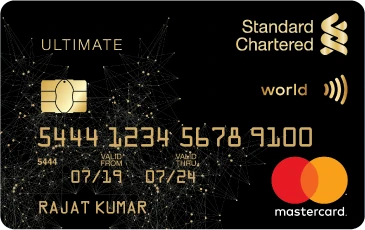
Standard Chartered Ultimate Credit Card
4.6Annual fee ₹5,000Ultimate offers about 3.33% on ordinary eligible purchases at its ₹1-per-point redemption value, but not on every payment. Education and specified property, government and insurance-related categories have lower earning.
Read the full review →

American Express
American Express Platinum Travel Credit Card
4.5Annual fee ₹5,000The important calculation is whether your qualifying annual spending reaches its milestone levels. Ordinary rewards alone are modest at our point valuation, and the travel name does not remove foreign-currency charges. New applications are currently paused.
Read the full review →

HDFC Bank
HDFC Bank Diners Club Black Metal Edition Credit Card
4.5Annual fee ₹10,000The value depends on how you redeem points and where Diners is accepted. A 10,000-point quarterly milestone is worth ₹3,000 at our ₹0.30 comparison value, not ₹10,000 cash. SmartBuy offers need their own multiplier and bonus-cap calculation.
Read the full review →

Axis Bank
Axis Atlas Credit Card
4.4Annual fee ₹5,000Atlas is strongest when purchases qualify for its travel earning rate and you can use EDGE Miles. Our 4% travel and 1.6% ordinary-spend figures assume ₹0.80 per mile; they are comparison values, not cash promised by Axis.
Read the full review →
Over ₹10,000 a year
Super-premium. Each review shows the spend at which the fee breaks even, or says plainly that it never does.

HDFC Bank
HDFC Bank Infinia Metal Edition Credit Card
4.9Annual fee ₹12,500Infinia’s 5 points per ₹150 can produce about 3.33% on eligible ₹1-per-point travel redemption, but only 1% at our ₹0.30 comparison value. Fee waiver, reward value and retention are three different tests.
Read the full review →

American Express
American Express Platinum Charge Card
4.8Annual fee ₹66,000A benefits-led charge card for frequent travellers who pay in full. Ordinary eligible spending returns 0.625% at our point valuation; fuel and selected promotions earn differently. Check guest charges, insurance limits and your renewal voucher before deciding whether the ₹77,880 annual fee works for you. New applications are paused.
Read the full review →

Axis Bank
Axis Bank Reserve Credit Card
4.7Annual fee ₹50,000Reserve’s standard annual fee is ₹59,000 including GST. Ordinary domestic rewards are about 1.5% at our point value; the higher international rate must not be applied to all travel or dining spending. Its benefit package needs a personal valuation.
Read the full review →

ICICI Bank
ICICI Bank Emeralde Credit Card
4.6Annual fee ₹12,000The standard Emeralde card’s reward rate and benefits should be assessed against its ₹14,160 annual fee including GST. It is a separate product from Emeralde Private Metal, so do not borrow that variant’s welcome benefits or earning rates.
Read the full review →

Axis Bank
Axis Bank Magnus Credit Card
4.3Annual fee ₹12,500Magnus earns approximately 1.2% at our ₹0.20 point value on ordinary eligible spending up to ₹1.5 lakh a month, then 3.5% on eligible excess spending. The standard fee is ₹14,750 including GST; the spend waiver requires ₹25 lakh of qualifying annual spending.
Read the full review →